
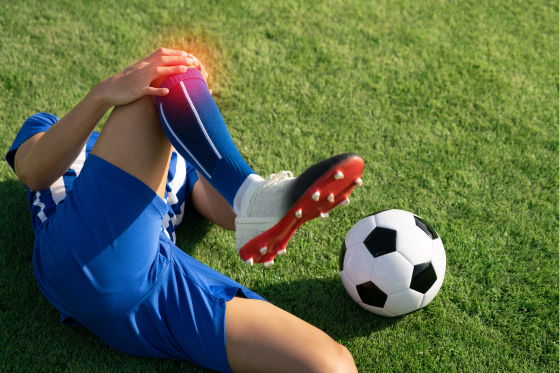
A parent brings in a young athlete with sore knees. The story sounds identical every time — it hurts after practice, it’s been going on a few weeks, they don’t want to stop playing.
But the same complaint, in the same sport, means genuinely different things depending on where that athlete sits in their physical development. The tissues that fail are different. The timelines are different. And the right response is different.
Chronological age is a poor guide here, because two 13-year-olds can be years apart in maturity. What matters is the stage. Here are the three that count.
Stage One: Before the Growth Spurt
Roughly: Up to around age 9 to 11 in girls and 11 to 13 in boys, though individual variation is wide.
What’s physically true: Growth plates are open and active. These are areas of cartilage near the ends of bones and where major tendons attach, and they are the weakest link in the chain — weaker than the tendon or ligament pulling on them.
What that means practically: In an adult, a hard pull through a tendon strains the tendon. In a skeletally immature athlete, that same force is more likely to irritate the growth plate the tendon attaches to.
The injuries that show up here:
Osgood-Schlatter — pain and often a tender bump just below the kneecap, where the patellar tendon attaches. Common in jumping and running sports.
Sever’s disease — heel pain at the back of the heel where the Achilles attaches. Extremely common in soccer, basketball, and any sport on hard surfaces.
Sinding-Larsen-Johansson — pain at the bottom of the kneecap.
Little League elbow and shoulder — growth plate stress at the elbow and upper arm in throwing athletes.
What parents most need to know: These are not “growing pains,” and they’re not something to push through. They’re loading problems at vulnerable sites, and they respond well to modified activity, targeted strengthening, and time — provided they’re identified rather than ignored for a season.
The rule that matters most at this stage: any persistent pain in a skeletally immature athlete deserves assessment. There is no version of “walk it off” that applies to a growth plate.
Stage Two: Through the Growth Spurt
Roughly: Around ages 9 to 10 in girls and 11 to 12 in boys, though again this varies substantially between individuals.
What’s physically true: Bone lengthens before the surrounding muscle and tendon adapt. Limb proportions change over months. The athlete’s sense of where their body is in space — built up over years — is suddenly working from outdated information.
What that looks like: A previously coordinated athlete becomes temporarily clumsy. Flexibility appears to decrease. Skills that were automatic need conscious thought again. Parents and coaches sometimes read this as a loss of focus or effort. It usually isn’t.
Why this window matters: Injuries during this period tend to occur at vulnerable sites — growth plates and tendon attachment points. Sports medicine guidance is fairly consistent that the most intense competitive training is better placed after an athlete has passed peak height velocity rather than during it.
An important nuance, because this often gets oversimplified: in Jayanthi’s study of nearly 1,200 young athletes, growth rate itself was not related to injury risk — injured and uninjured athletes were growing at essentially the same speed. The vulnerability comes from skeletal immaturity and from training load applied during that period, not from the fact of growing quickly.
That’s a useful distinction. You can’t slow a growth spurt. You can absolutely manage the training load applied across it.
What to do: This is the stage to hold volume steady rather than escalating it, prioritize movement quality over intensity, keep the athlete in more than one activity, and expect a temporary dip in performance that isn’t a cause for concern.
Stage Three: After the Growth Spurt
Roughly: Mid-to-late adolescence, once height has largely stabilized.
What’s physically true: Growth plates gradually close. Strength gains become far more responsive to training, particularly in boys with rising testosterone. Adult tissue patterns take over.
What changes: The injuries shift toward adult presentations — ligament injuries including ACL tears, tendinopathies, stress fractures, and muscle strains.
The ACL point deserves specific mention. Adolescent female athletes carry a notably elevated risk of ACL injury compared with their male counterparts in comparable sports. Structured neuromuscular training programs — landing mechanics, deceleration, hip and hamstring strength, plyometrics — have a solid evidence base for reducing that risk, and they work best when they become part of routine warm-ups rather than a separate project.
What this stage allows: This is when progressive resistance training becomes genuinely productive, and when higher competitive training loads are more appropriate.
What it doesn’t excuse: the accumulated load from the previous stages. Plenty of injuries appearing at 16 have their origins in three years of year-round play at 12.
Why Kids Underreport
Whatever the stage, there’s a consistent obstacle: young athletes frequently don’t tell anyone.
They’re worried about losing their spot. They don’t want to let the team down. They’ve absorbed a culture where playing through pain is admirable. And sometimes they genuinely can’t tell the difference between normal training soreness and something that needs attention.
Signs worth watching for when nothing has been said:
A change in how they move — limping, favoring a side, altered technique. Reduced enthusiasm for a sport they used to love. Icing something quietly after games. Avoiding a specific movement. Asking to skip practice for vague reasons. Dropping performance without an obvious explanation.
Asking “does anything hurt?” often produces a no. Asking “is there anything that only bothers you during games?” or “what’s the first thing that gets sore?” tends to work better.
When to Get It Checked
Get an assessment for pain lasting more than two weeks; any pain in a skeletally immature athlete that recurs with activity; pain that’s changing how they move; night pain; pain that’s getting worse rather than fluctuating; swelling; a joint that gives way, locks, or catches; or any noticeable difference between sides.
Seek urgent medical care for an inability to bear weight, obvious deformity, a joint dislocation, significant swelling immediately after an injury, or any suspected head injury.
Head injuries need their own pathway. Any suspected concussion means removal from play that day and clearance through the appropriate return-to-play protocol before returning. No exceptions, regardless of what’s at stake in the season.
The Thing Worth Saying to Your Athlete
Most young athletes believe that reporting pain costs them playing time.
The honest version is the opposite. A niggle addressed in two weeks costs a couple of weeks. The same niggle ignored for a season costs months — and in growth plate injuries, occasionally more than that.
Kids respond to that framing far better than to being told to be careful.
Get an Assessment That Accounts for Their Stage
Advice written for adults doesn’t transfer cleanly to a body that’s still developing, and advice written for 17-year-olds doesn’t fit an 11-year-old.
Houghton Physical Therapy offers a free discovery visit at no cost and no obligation. You’ll get an assessment that accounts for where your athlete actually is developmentally, a clear explanation of what’s driving their symptoms, and a plan that keeps them playing where that’s safe — and tells you honestly when it isn’t.
If your athlete’s presentation needs imaging or a physician’s opinion, we’ll say so plainly and help you get there.
Book your free discovery visit today.
Tags: knee pain, sports injuries, youth athlete