
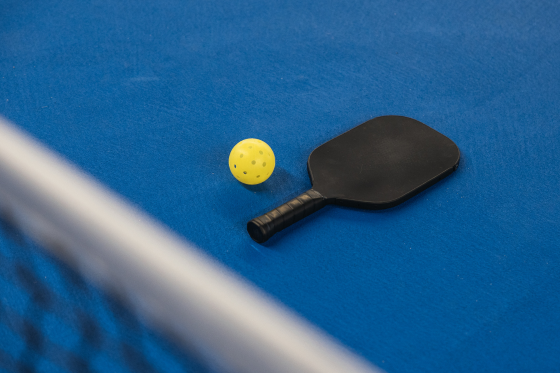
Most pickleball improvement advice is about strategy and technique. Dink patterns, third shot drops, court positioning, paddle selection.
All useful. But a fair number of the points recreational players lose aren’t tactical or technical at all. They’re physical — the ball was reachable, the shot was known, and the body didn’t get there in time or in a position to hit it well.
That’s a different problem, and it responds to different training.
Here are the four physical limiters that cost recreational players the most, each with a way to test yourself and what to do about it.
Limiter One: Your First Step
How it shows up: You read the ball correctly and still arrive late. You end up reaching or lunging for balls you should have been able to step to. Your partner covers more of the court than seems fair.
What’s actually happening: First-step quickness depends on being in a loaded, ready position and being able to produce force quickly from it. Two things commonly go wrong — standing flat-footed and upright when your opponent strikes, and lacking the explosive capacity to accelerate even when you’re ready.
Test yourself: Stand in your ready position and have someone point randomly left or right. How quickly do you produce the first step? Better still: film a few rallies. Most players are surprised by how upright and static they look at the moment of their opponent’s contact.
What to train:
The split step, deliberately, until it’s automatic. A small hop landing as your opponent strikes, so you land loaded rather than flat.
Explosive lower body work — jumps, hops, and skips, built up gradually. Explosive force production is what accelerates you, and it declines faster with age than general strength does when nothing is done about it.
Basic strength underneath it. You can’t be explosive from a base you don’t have.
Limiter Two: Staying Low
How it shows up: You start rallies in a decent athletic position and gradually stand up as the game goes on. Your dinks get looser. You pop balls up at the kitchen line because you’re reaching down rather than getting down.
What’s actually happening: Holding a semi-crouched athletic position is a strength endurance demand. It also requires ankle dorsiflexion — the ability for your knee to travel forward over your foot — and hip mobility. If any of those are limited, standing up is what your body does instead.
Test yourself: Kneel with one foot forward and drive that knee past your toes with the heel flat on the floor. Compare sides. Then try holding a comfortable athletic stance for 60 seconds and notice what fatigues.
What to train:
Ankle mobility if it’s restricted — common in anyone with a history of sprains or Achilles trouble.
Squat and split squat strength, which is what lets you hold and move from a low position without your legs complaining after game two.
Practice at the kitchen line specifically. Dinking drills done properly are strength endurance work as well as skill work.
Limiter Three: Moving Sideways
How it shows up: You’re fine moving forward and awkward moving laterally. You cross your feet, get caught leaning, or find yourself off balance after a wide ball. Recovery to the center is slow.
What’s actually happening: Lateral movement demands push-off strength from the outside leg, hip control, and the ability to decelerate — which is genuinely harder than accelerating and much less commonly trained.
Test yourself: Stand on one leg with your eyes open, then try 30 seconds. Then try a small lateral hop and stick the landing without wobbling. Compare sides. A clear difference between sides shows up in your court coverage on one wing.
What to train:
Lateral lunges and side steps under load.
Gluteus medius work — this muscle controls the pelvis and resists collapse when you push off sideways, and it’s weak in most recreational players.
Deceleration practice: small lateral bounds where the goal is landing under control rather than covering distance.
Limiter Four: The Third Hour
How it shows up: You play well for an hour and then progressively less well. Unforced errors climb. Your footwork gets lazy. You start reaching instead of moving.
What’s actually happening: Two separate things, and it’s worth knowing which is yours.
Cardiovascular — you’re genuinely out of breath and not recovering between points. Research on players averaging 62 found more than 70% of playing time spent in the moderate-to-vigorous heart rate zone, so the demand is real.
Muscular — your breathing is fine but your legs are done. This is more common in recreational players and points to strength capacity rather than fitness.
Test yourself: During your next long session, notice what actually limits you at the two-hour mark. Are you breathing hard, or are your legs heavy? The answer determines what to train.
What to train:
For the cardiovascular version: some steady aerobic work on non-playing days, plus interval work that mimics the sport’s stop-start pattern.
For the muscular version: strength training. Legs that are stronger relative to the demand fatigue later.
For both: sleep, hydration, and eating properly before a long session — all of which get overlooked and all of which affect the third hour more than the first.
Why This Matters Beyond the Scoreboard
Every limiter above is also a risk factor.
Arriving late to balls produces desperate lunges. Standing tall reduces your ability to react. Poor lateral control is how ankles roll. And fatigue amplifies everything — it’s the condition under which most injuries actually occur, because coordination and protective responses degrade.
So the training that makes you better is largely the same training that keeps you playing. That’s a convenient overlap and it’s worth exploiting.
The Weekly Structure That Works
For most recreational players wanting to improve:
Two strength sessions, covering legs, hips, calves, and shoulders, progressed over time.
A small amount of explosive work — jumps, hops, skips — built up gradually and done fresh rather than at the end of a session.
Your usual playing, with genuine rest days between the harder sessions.
Ten minutes of warm-up before you play. Easy movement, leg swings, lunges, a few accelerations, then dinking. The first game is not a warm-up, and the players who treat it as one are the ones arriving late to balls for the whole first game.
Before You Start Explosive Work
Jumping and hopping are the most demanding items above and need building up sensibly rather than starting at volume. Get assessed first if you have current or recent knee, ankle, hip, or back pain, a history of Achilles problems or ankle sprains, a joint replacement, osteoporosis or reduced bone density, or if you’ve been largely inactive.
Speak to your physician before beginning a new exercise program if you have cardiovascular risk factors, and seek emergency care for chest pain, unusual breathlessness, dizziness, or fainting during play.
Find Your Actual Limiter
Guessing which of the four is costing you most is harder than it looks, and training the wrong one is a slow way to make progress.
Houghton Physical Therapy offers a free discovery visit at no cost and no obligation. You’ll get an assessment of your strength, power, mobility, and single-leg control, a clear picture of which limiter is actually costing you points, and a program targeted at it.
Book your free discovery visit today.
Tags: pickleball, sports injuries